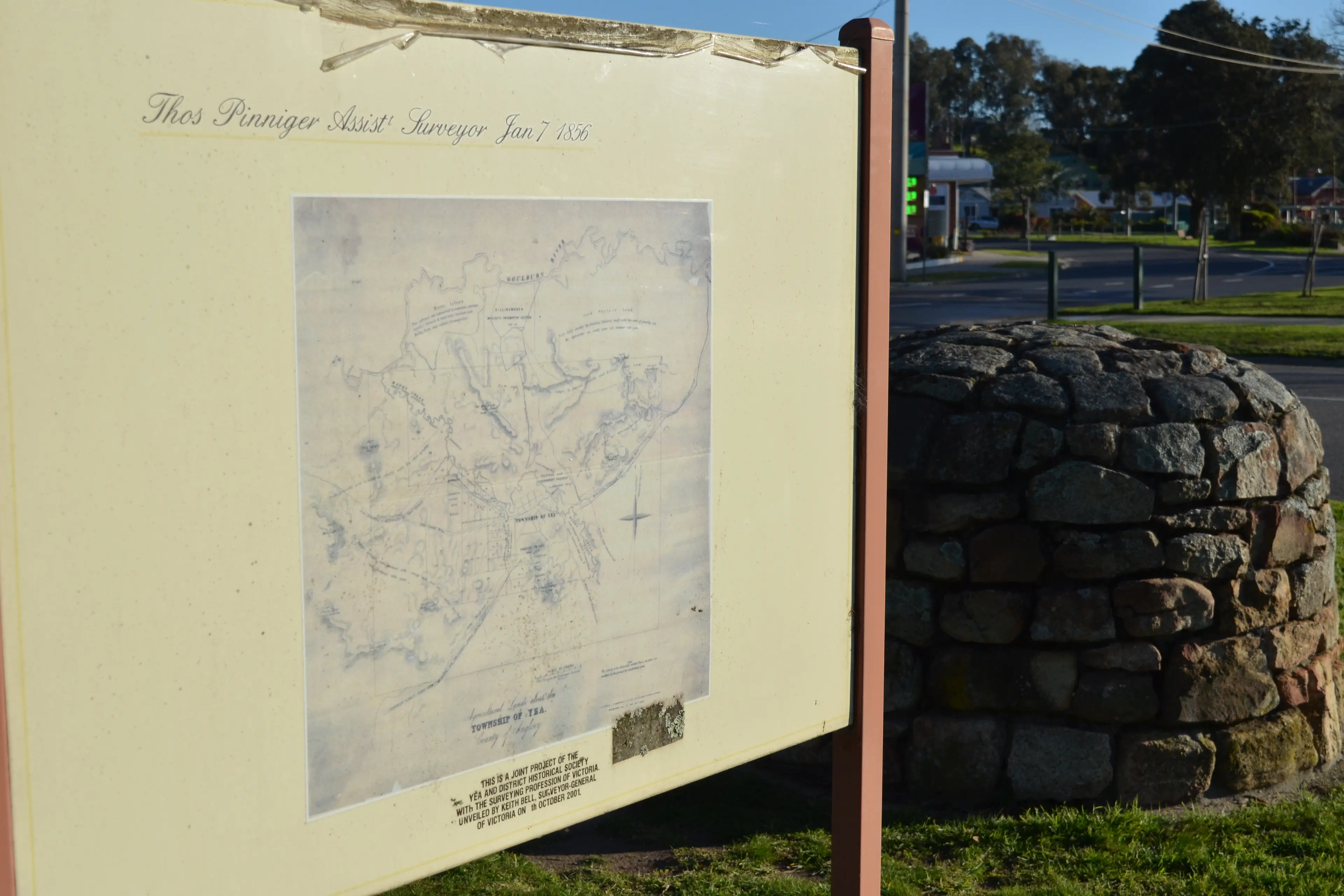
LAWRIE Hall, the great-great-grandson of Selina Johnson and William Fenton, has kindly provided some of his family history research. It includes a sad tale from the history of our local area. Henry Johnson was born around 1811 in Leicestershire and arrived in Australia aboard a convict ship Westmoreland in 1835, possibly as the result of poaching pheasants. He married Isabella Luckie in May 1845 by the banks of the Goulburn River, although it is possible from Lawrie’s research that he may have left a wife and child behind in England. He arrived at Beaumonto, on the banks of the Yea River later in the year that he arrived. A Johnson descendant has a book with handwriting which reads ‘Henery Johnson Burnnanto 1835’. An additional map spelling is Bummanto, as it evolved over time. It was located to the west of what is now the racecourse in Yea, and may have been within the Doogalook pastoral area. 1835 was also the same year that Melbourne was founded, with around 200 colonists arriving that year. Henry was present at the start of European settlement in the Yea area. Henry also owned the Taggerty Run from 1849, likely concurrent with Beaumanto until 1864. James Webster owned the Eglinton Run until 1858, when it was purchased by Henry and Robert Nicholas, and then from 1859 to 1881 by Henry alone. While it is not known whether Henry was personally involved, there are historical examples of terrible mistreatment of Indigenous people living in Victoria. It is estimated that massacres by European settlers resulted in the deaths of approximately 11 per cent of the Indigenous population between 1836 and 1851 in Victoria. The Acheron Aboriginal Reserve was created on the Taggerty Run in 1859. The book, On Taungurung Land by Uncle Roy Paterson and Jennifer Jones states, “The land selected by Taungurung leaders fell within the ‘pre-emptive right’ of Henry Johnson, who held Taggerty Station from 1849 to 1864. Under regulations gazetted in 1848, a pre-emptive right allowed squatters to purchase a homestead block of 640 acres within their leasehold, before the ‘land in their locality was made available to the general public’. Given these entitlements, and the widely held view that the pre-emptive section of Taggerty would be “depreciated in value by the establishment of the proposed Aboriginal Reserve,” officials expected that Henry Johnson would object to the Taungurung selection. This was the case. In January 1860, District Surveyor F Pinniger reported to the commissioner of lands that ‘the present owner of Taggerty does object to being surrounded by an Aboriginal reserve and seems to consider the present survey a hardship upon him.” The Acheron Aboriginal Reserve is now the site of Taggerty township. In September 1860, the Taungurung clans were evicted from the Acheron Aboriginal Reserve and it was demanded that they move to Mohican Station, which they objected to. Many refused, camping in Narbethong instead. Confusingly, Mohican Station is often still referred to as Acheron Station. Indigenous people were often employed by pastoralists to shear sheep, construct fencing and strip bark. Henry employed Indigenous people on the Taggerty Run, but it is not known in what capacity. Indigenous man, Bornootkurian, known as Davy Hunter, worked for Henry for a period of time. Henry and Isabelle’s children were John (who drowned as a toddler in 1844 during a flash flood), Selina, Josephine, Mary Ann (who died in a horse-riding accident when aged in her early teens), Robert, Alfred and Henry Joseph. Many people in Murrindindi Shire are descended from this family. Selina Johnson was born on the banks of the Goulburn River around 1846. Selina formed a secret intimate relationship with Bornootkurian, known as Davy Hunter, while she was in her late teens. The Taungurung clans had been living at the Acheron Station before then being moved to Mohican Station. In the summary of Liz Reed’s White girl ‘gone off with the blacks’ it states, “The event occurred at a significant time in Victoria’s evolving race relations, which were marked by a renewed humanitarian attitude towards Aborigines, albeit one tinged with paternalism and a sense of racial superiority.” She later states, “The sexual and emotional involvement of a 'white girl' with an 'Aboriginal' man was something yet to be encountered by colonial officials who implicitly denied the possibility of agency on the part both of women (white or Aboriginal) and of Aborigines.” Aldo Massola reports, in an investigation after the fact, that Henry Johnson noticed Selina was showing signs of pregnancy when she was aged 19 (although Lawrie Hall notes that based on her birth certificate, Selina was in fact 17). The age of consent for girls at the time was 12. When Selina was questioned by her father, she admitted to having on several occasions met a man, but she refused to give his name. She was a willing party, and no force was used. Selina was kept in confinement but managed to escape and join Davy in the bush. It appears that this was immediately prior to Selina giving birth, and may have been during labour. Henry sought assistance from Robert Hickson, at the time Superintendent of Acheron (Mohican) Station. A letter from Hickson to the board outlines that he attempted to locate Selina through interviewing Davy. Davy said he was the father of Selina’s child, that Selina had consented to be his wife and this he considered her to be. Selina had been missing for three days when Hickson then located her and returned her to her parents. While in the bush, she had delivered a child, James Wilson Boyd Johnson. A letter from William Thomas indicates that although there was no force on the part of Davy and therefore Davy could not be arrested, he says, “Had the child lived, I would have suggested to prevent the disgraceful reoccurrence of the like, that the child should have been sworn to the black for maintenance, which of a matter of course he would not be able to pay, and place him in prison in default.” This was a hypocritical statement given that white men were not held to account for children they had with Indigenous women. The baby, James Wilson Boyd Johnson, died aged just 15 days (not 17 days as reported by Massola), on September 12, 1861. He was buried at a location then known as Emu Hill, likely on the Eglinton Run property. Henry Johnson was the undertaker. Henry did not report the death until November 6. There was no record of a doctor examining the child, and the cause of death was reported as “inflammation.” This, of course, raises questions. Selina was determined to be with Davy and declared her intention to marry him when she turned 21, the age at which parental consent was not required for marriage. It was likely that the young couple never saw each other again, as Davy soon moved with the rest of his clans to Corranderrk near Healesville. There were claims that in order to thwart his daughter’s desire to marry Davy, Henry “…offered even his station to any white man that will marry her,” according to an 1862 source. Three months prior to her 21st birthday, Selina and William Fenton were married. There are no signs of Henry showing any formal support for the marriage, and no station was provided. They had one son, but the marriage did not last beyond a few years. They separated and William moved away. He lived for another 30 years. Selina then married Thomas Dunn, possibly bigamously, in 1877, claiming that she was a widow. She had a daughter with Thomas. When Selina’s father Henry passed away, he left Selina 50 pounds, from an estate valued at over 2000 pounds. As mentioned, the birth of Selina and Davy’s child occurred on August 28, 1861. In March 1862, after a further move to a different location, the government decided to ‘break up’ the Mohican Station altogether. The Taungurung by this stage were tired and disheartened. Uncle Roy recounted, “They weren’t even asked; they were just told to get out. That’s where the Wurundjeri mob come up and grabbed them and took them back to Coranderrk.” John Green arrived to take charge of Mohican Station in March 1862. A month prior, he had taken Davy Hunter on a trip to Melbourne, attending an exhibition at the Museum of Illustration. John Green recounts Davy being struck by the beauty of the woman in a Sleeping Beauty image. It is not known what happened to Davy Hunter after this time. He disappeared from the public record. Selina Johnson died in 1920, aged 77. She is buried in the Alexandra Cemetery. The Taungurung Land and Waters Council, Alexandra Historical Society and additional members of the Johnson family were consulted regarding this article.