Like reading the news? Have a paper copy of the weekly news posted to you for just $15 per month.
Interested? Click here to learn more.

Publishers of
the Alexandra Standard and
the Yea Chronicle.

The Alexandra Eildon Marysville Standard

The Yea Chronicle

150+ years serving the Murrindindi region

And our most valued reader is still YOU.

Read the newspaper online

Interested in reading the news online? You can.

Alexandra Newspapers offers a digital subscription service allowing you to read the Alexandra Standard and the Yea Chronicle online.

If you're a current subscriber, or interested in purchasing a subscription, click the link below.

Rotary sources amenities unit for Highlands

Rotary sources amenities unit for Highlands

THE Rotary Club of Yea became aware of the availability of an amenities trailer, located in Gippsland, that had been created in the aftermath of the Black Summer bushfires in...
Alexandra B Grade into the SDCA grand final

Alexandra B Grade into the SDCA grand final

Alexandra 5/113 defeated Puckapunyal 10/110 THE Alexandra Redbacks B-Grade team defied the odds last Saturday to upset Puckapunyal in the semi-final with a convincing five wicket win. This victory has...
Merton cricketers secure place in WDCA grand final

Merton cricketers secure place in WDCA grand final

Charity day at Marysville Golf Club

Charity day at Marysville Golf Club

Pre-season training underway for AFNC

Pre-season training underway for AFNC

Eildon golfers enjoy fine course conditions

Eildon golfers enjoy fine course conditions

And in other news!

Here's what's happening on our Facebook Page.

Comments Box SVG iconsUsed for the like, share, comment, and reaction icons

FIRE RESTRICTIONS TO END IN PARTS OF NORTH EAST AND WEST REGIONS
The Fire Danger Period (FDP) will officially end at 1am on Monday, March 30 in the following municipalities within CFA District’s 12, 13, 22 and 17.
• Knox City Council
• Maroondah City Council
• Manningham Council
• Yarra Ranges Shire Council
• Greater Shepparton City Council
• Moira Shire Council
• Strathbogie Shire Council
• Mitchell Shire Council
• Murrindindi Shire Council
• Hindmarsh Shire Council
• Yarriambiack Shire Council (central)
• West Wimmera Shire Council (north of the Wimmera Highway including the townships of Edenhope and Apsley)

It has been a long and challenging fire season and as we head into autumn, there is still heightened fire risk, with dry weather expected for many more months.

As fire restrictions begin to lift, CFA is urging residents to remain alert as the current and continued conditions can still lead to fast-moving grassfires even in cooler weather.

CFA Deputy Chief Officer for North East region Gavin Thompson, said the easing of restrictions was due to a number of favourable factors in some areas.

“Recent fires in these areas have shown less intensity due to some recent rainfall,” Gavin said.

“Nights are becoming increasingly cool, and we are seeing dew in the mornings that further reduces our fire risk.”

CFA Deputy Chief Officer for West region Steve Alcock said while the FDP will end in these municipalities, people are urged to still remain vigilant.

“Even with milder weather we still want landowners to take precautions and ensure conditions are safe before burning off, and that someone is in attendance at all times to monitor the burn,” Steve said.

“Some of our neighbouring municipalities will still be under FDP restrictions, so it is important to always check your local restrictions before burning off to see if a permit is needed.”

Residents travelling to other parts of Victoria are reminded to remain vigilant and to check the Fire Danger Periods that are in place in the region they are residing.

With the end of the FDP, some landowners may choose to resume burn-offs, but it’s essential to take precautions and ensure conditions are safe before proceeding.

To prevent unnecessary emergency callouts, landowners must register their burn-offs. If smoke or fire is reported, it will be cross-checked with the register to avoid an emergency response.

Burn-offs can be registered online at www.firepermits.vic.gov.au or by calling 1800 668 511.

Where possible, landowners should also notify neighbours and those nearby who may be sensitive to smoke.

Burn-off safety checklist
• Check fire restrictions in your area and register your burn-off.
• Monitor weather conditions, especially wind.
• Notify neighbours to prevent unnecessary emergency calls.
• Maintain a three-metre firebreak, clear of flammable materials.
• Have enough equipment and water to contain the fire.
• Never leave a burn-off unattended – stay until it is fully extinguished.
• If your burn-off gets out of control, call 000 immediately.

For tips on protecting your health from smoke, visit the EPA Victoria website.
... See MoreSee Less

$140,000 FOR SHAPING MURRINDINDI'S FUTURE
Minister Ros Spence today announced more than $390,000 for projects that create jobs in forestry areas.

The Shaping Murrindindi’s Future project received $140,000 to improve visitor experiences through three key projects – Beyond the Black Spur, Ride Marysville and the Triangle Food Network pilot.

The Beyond the Black Spur project will explore local tourism opportunities, with initiatives such as Ride Marysville that will investigate how Marysville can position itself as a premier mountain biking destination.

The Triangle Food Network pilot will develop a five-acre hybrid community and market garden, bringing local growers, producers, community members, tourism operators and visitors together.

Minister Spence said, “We’re putting regional communities first, driving job creation, strengthening local businesses, and ensuring opportunities stay where people live and work. This investment will support community-led projects and bring more visitors to regional Victoria.

Member for Northern Victoria Jaclyn Symes said, “Only Labor can bring more investment into the regions – helping Victorians grow their businessesin the north east."

More in next week's edition.
... See MoreSee Less

What can we actually do to help communities recover after bushfire?

Over the past 10 weeks, we’ve had a steady stream of messages, texts and emails asking the same question:

“What can we do to help?”

It’s a good question.

And the answer isn’t complicated—but it does need to be understood.

Around 10 weeks on from the Longwood fires, from what I’m seeing on the ground across Fawcett and Koriella and the wider Murrindindi Shire—Cathkin, Molesworth, Yarck, Kanumbra, Ut Creek Road, Ruffy, Terip Terip, Maintongoon, Alexandra and Merton...recovery isn’t one big solution.

It’s a series of small, practical actions that add up.

And when you strip it back, communities need three things:

1. Cash works best
Not stuff. Not clutter.

Cash gives people choice.
It gets support where it’s needed fast.
And it supports local businesses at the same time.

At Fawcett Hall, we’ve put around $30,000 straight back into the immediate community through local business vouchers—funded by donations received locally, nationally and internationally (including a generator jerry can swap at the hall).

It worked because it was simple, local and immediate.

2. Clear, honest information matters
People don’t need jargon or noise.

They need to understand:
What’s happening
What support exists
What to do next

We’ve come back to the KISS method time and time again.

Because when people are dealing with bushfire trauma, there is very little capacity left.
Trust me on this one—we all get foggy and tired quickly.

And not everyone has strong digital literacy—or stable internet. #blackspot

Simple, consistent communication makes recovery smoother.

3. Communities lead their own recovery
The people living it know what they need.

The best outcomes happen when support wraps around communities—not over the top of them.

Local halls, local groups, local leaders—they matter more than people realise.

So what does this actually look like in practice?
Here’s what’s making a real difference:

* Back local halls and community groups

- Give small, flexible funding—$1,000 to $2,000—and let communities decide what’s needed.
- Meals, catch-ups, working bees, garden blitzes, informal gatherings, even small music or cultural events.
- $5,000–$10,000 can fund a generator so the next power outage doesn’t stop everything.
- Keep conditions and paperwork light—we don’t have the brain space.

Even better—have the conversation first, then help complete the forms.

This is where connection happens.
And connection is recovery.

* Invest in fencing materials (and support local businesses at the same time)

It’s not flashy, but it’s one of the biggest pressure points.

Fencing is infrastructure.
It’s safety.
It’s the ability to run stock again.

For many—especially those underinsured—it’s the difference between moving forward or standing still.

For context:
Black steel posts range from $6–$12 each. A 2.5mm x 1500m wire coil is around $250.

Across our region, we estimate around 500,000 posts are needed.

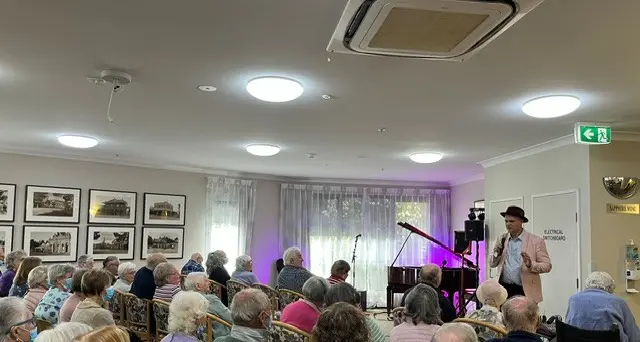
* Support community-led thank you moments

- Dinners, BBQs, lunches, simple gatherings.
- A chance to acknowledge volunteers, hall teams, CFA crews, neighbours and families.
These aren’t just “nice to have.”

They rebuild identity, pride and momentum—things that quietly disappear after a disaster.

And here’s the part that often gets missed:

Recovery isn’t about going back to how things were.
It’s about helping people move forward into what life looks like now.

After the 2009 fires, it was called the “new normal.”
That still holds true.

This isn’t theory.
This is what we’re seeing play out every day.

When support is practical, local and flexible—it works.
When it’s delayed, mismatched or overcomplicated—it slows things down.

If you want to help:

Keep it simple.
Back people.
Back communities—their hubs, their halls.

That’s where the real impact is.

Opinion/Observation piece - Pres Sam

📷 Photo of remnant of front fence at Fawcett Hall atop new fence in view built by Operation Vet Assist.

Autumn morning shows burnt tree with epicormic shoots and burnt trees along creek.
Scorched earth, dead leaves in patches in foreground.

#green #stillburnt #CommunityLedRecovery
... See MoreSee Less

🚜 Fuel and fertiliser access critical for bushfire recovery

Murrindindi Shire Council is calling on State and Federal Governments to prioritise access to fuel and fertiliser for bushfire-impacted communities.

Following the January 2026 fires, reliable access to diesel and fertiliser is essential to support clean-up, rebuild fencing, restore pasture and keep farms operating.

Mayor Damien Gallagher, Murrindindi Shire Councillor said recovery depends on being able to act quickly.

“Fuel is not optional in a recovery like this - it underpins every part of getting people back on their feet.”

“With fencing losses alone estimated to exceed $120 million, our community cannot afford further delays or cost pressures.”

Council is advocating for practical support, including:
✔️ Priority access to fuel for producers and recovery works
✔️ Financial support to offset rising fuel costs
✔️ Action to stabilise fertiliser supply

This is about ensuring our community can recover, rebuild and remain viable.

🔗 Read the full media release:
www.murrindindi.vic.gov.au/Council/News-and-Media/Council-News/Council-calls-on-Government-to-pri...
... See MoreSee Less

Load more

© 2020 - 2026. ALEXANDRA NEWSPAPERS. All rights reserved.
Privacy Policy | Terms of Use | Sitemap

Website built with ❤ by Regional Business Toolkit